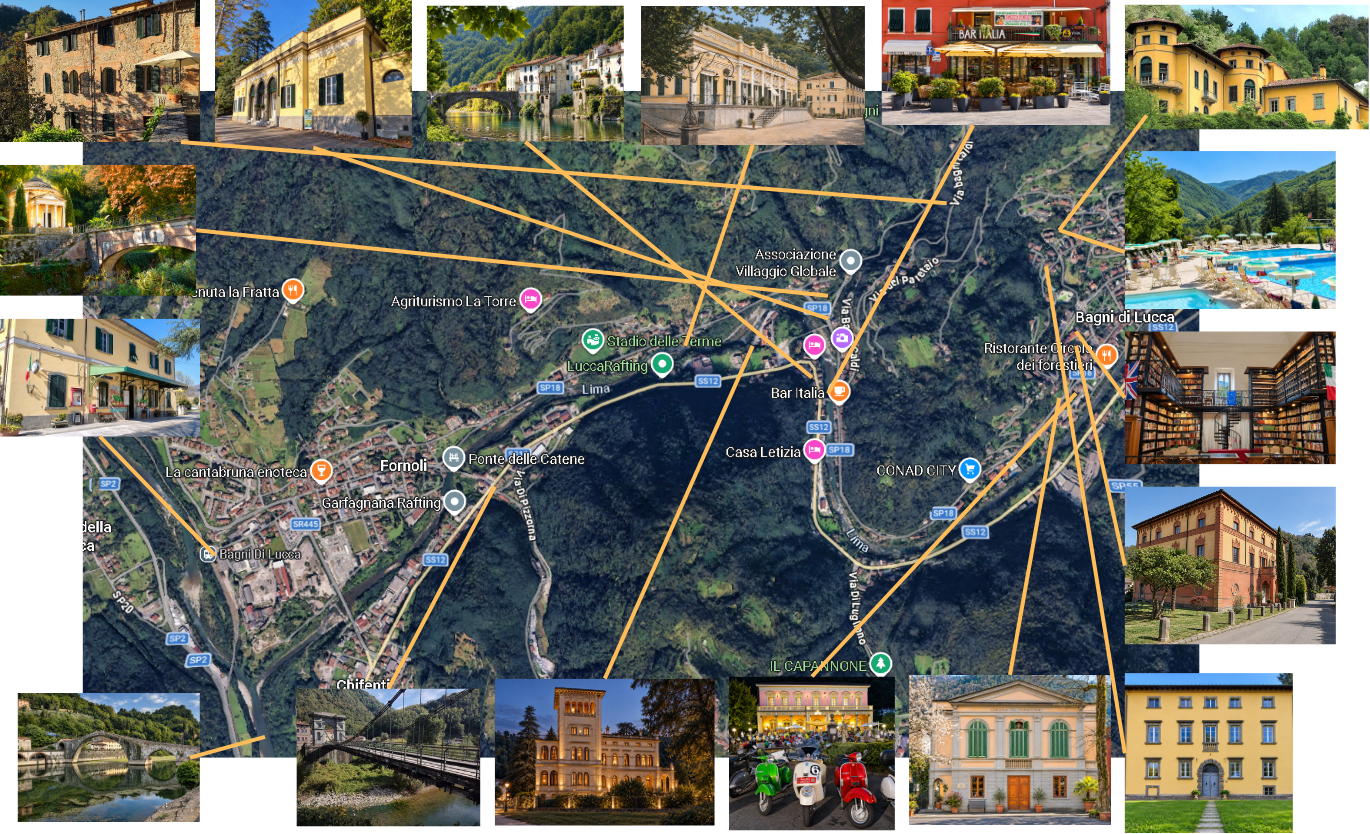
Map of Bagni di Lucca and Fornoli with photos of the main attractions, including Ponte delle Catene, Ponte della Maddalena, Villa Ada pools, Bar Italia and the English library
Val di Lima · Lucca province

Things to see in Bagni di Lucca

Historic spa buildings, riverside settlements, the Chain Bridge, traces of the town’s English community and a dramatic mountain canyon. Here is what to see in the town and across the wider municipality.

In and around the town

10 attractions
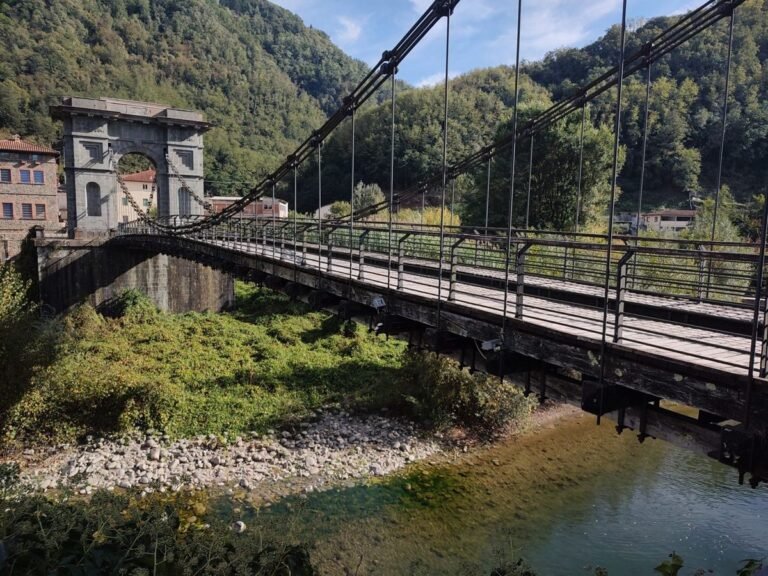
The Ponte delle Catene chain bridge over the Lima, with its stone arch and wooded hills behind
Architecture

Ponte delle CateneThe Chain Bridge

An unusual historic suspension bridge designed by Lorenzo Nottolini and completed in 1860. One of the area’s most distinctive architectural sights.

Fornoli

Read the history

Fornoli

The Ponte delle Catene spans the Lima between Fornoli and Chifenti, combining nineteenth-century engineering with the elegance of a monumental gateway. Commissioned by Carlo Ludovico di Borbone, Duke of Lucca, it was designed by Lorenzo Nottolini to replace an earlier crossing lost to flooding. Before developing his design, Nottolini travelled to Britain to study suspension bridges, drawing on technology that was still adventurous in Italy. Iron chains support the crossing between imposing stone gateways, giving the bridge its name and distinctive appearance.

Work began in 1840, but political and administrative changes delayed completion until 1860. The bridge was badly damaged by retreating German forces during the Second World War and reconstructed according to the original design, reopening in 1953. Its significance lies in this meeting of architectural grandeur and industrial innovation: a practical river crossing conceived as a statement of progress, and now an important landmark of the Lima valley.

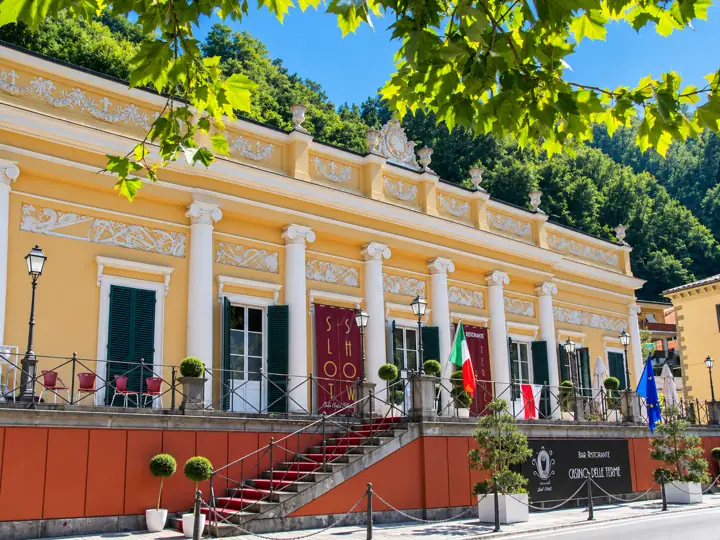
The yellow facade of the Real Casinò at Ponte a Serraglio, with white columns, green shutters and a red-carpeted staircase
Spa heritage

Ponte a Serraglio and the Real Casinò

Explore the riverside settlement and its historic casino, opened in 1839, a reminder of Bagni di Lucca’s days as a fashionable spa resort.

Ponte a Serraglio

Good to know: the building also hosts events. Check access before planning a visit inside.

Read the history

A fashionable spa society

Bagni di Lucca’s historic Royal Casino recalls elegant spa society, combining classical architecture, decorated interiors and a rich entertainment heritage.

Bagni di Lucca’s Royal Casino grew from a much older local tradition of regulated gambling associated with the thermal baths. Gaming revenues helped support charitable bathing and maintain spa facilities. By 1331, Lucca’s statutes regulated play, establishing a connection between entertainment and the welfare of visitors seeking the town’s waters.

The present building dates to 1839, when Duke Carlo Ludovico of Bourbon encouraged gambling’s relocation to Ponte a Serraglio. Court architect Giuseppe Pardini designed the casino, financed by French entrepreneurs Adrien Mathis and Edouard Ginnestet in exchange for gaming rights. Its elegant rooms accommodated gambling, reading, billiards and fashionable gatherings.

Artist Francesco Bianchi, nicknamed Diavoletto, decorated the interiors with imagery celebrating music, games and entertainment. Beyond its gaming tables, the casino hosted balls, concerts and literary occasions. When Lucca passed into Tuscany in 1847, Grand Duke Leopold II prohibited gambling, but the building retained its significance within the valley’s cultural life.

Culture

Teatro Accademico

Bagni di Lucca’s Teatro Accademico brings centuries of performance history to life, reflecting the spa town’s rich and distinctive cultural heritage.

Viale Umberto I, 103, Bagni di Lucca

Good to know: check the current programme and visiting arrangements before you go.

Read the history

A theatre built by its community

The Teatro Accademico began in 1790, when local residents formed the Accademia dei Provvidi and pledged fifty gold scudi each towards its construction. Their ambition was to create both a performance venue and a gathering place for the community. Modelled on larger theatres, the intimate building incorporated tiers of boxes.

Its flourishing years coincided with Bagni di Lucca’s popularity as an elegant European spa resort. Elisa Baciocchi Bonaparte, ruler of Lucca, attended performances and even appeared as Phaedra in Racine’s tragedy. During the nineteenth century, the theatre presented important operatic and dramatic productions, enriching the town’s lively cultural and social life.

In the twentieth century, local dramatic societies performed here, and the building also served as a cinema. Serious structural problems prompted its transfer to the municipality in 1978. Following restoration, it reopened in 1986, welcoming audiences again and establishing a winter programme featuring visiting theatre companies of national standing.

Points of interest

  • Traditional theatre architecture: if interior access is available, look for the tiers of boxes, designed to echo grander theatres within a small, intimate building.
  • A connection with Napoleon’s family: the stage hosted Elisa Baciocchi Bonaparte, Napoleon’s sister and ruler of Lucca, as a performer as well as a distinguished spectator.
  • Puccini’s early musical career: before completing his studies, the young Giacomo Puccini played piano in a small dance orchestra at the Teatro Accademico and other local venues.
  • Live performances: the theatre remains a cultural venue, with theatrical productions and the Teatro Scuola programme, which introduces children to performance. Check the current programme before planning an evening visit.
  • Finding the theatre: Viale Umberto I, 103, Bagni di Lucca. Confirm visiting arrangements beforehand, as regular sightseeing hours are not published.
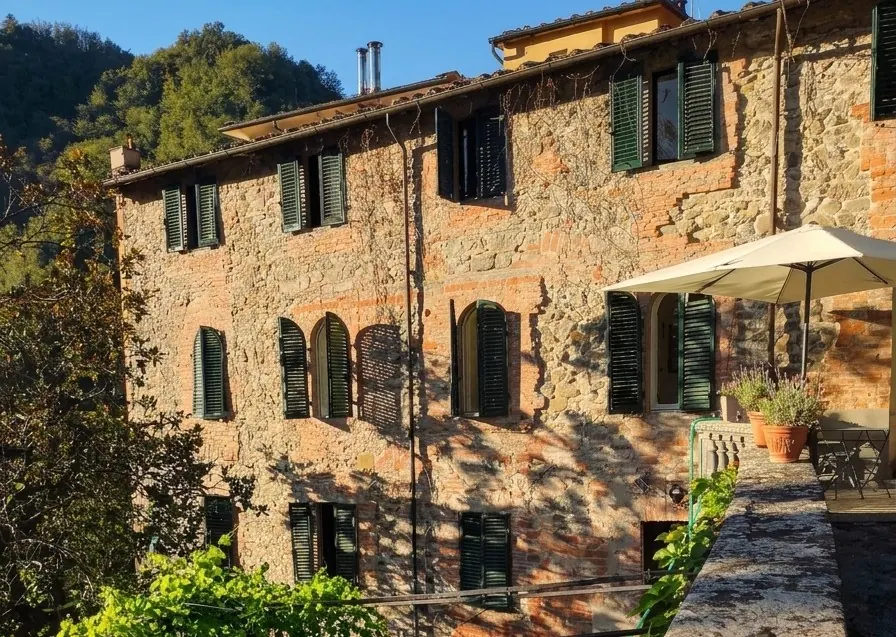
The stone and brick façade of Villa Ruspoli at Bagni Caldi, with green shutters and a terrace with a parasol and potted lavender
Villa heritage

Villa Ruspoli

A quiet villa above the thermal springs, once the Ruspoli family’s summer retreat and later a house for the clergy, now preparing to reopen as a restaurant and bar.

Via delle Selve, Bagni Caldi

Good to know: the restaurant and bar is due to open soon. Check it is open before planning a visit.

Read the history

A private summer retreat

Tucked into the wooded slopes of Bagni Caldi, a short walk from the thermal springs and the Lima torrent, Villa Ruspoli sits quietly on Via delle Selve. From its windows the view drops through green hills toward the river and the old bath establishments. It is not one of the grand ducal residences that once made this valley a summer capital of Europe. Its story is more intimate: a private retreat shaped by a noble family, a widow’s careful bequest, and long decades of religious use.

The villa owes its existence in its present form to Napoleone Ruspoli (1885–1935) and his American wife, Katherine Quay (1888–1956). Napoleone was the youngest son of Alessandro Ruspoli and the English Eva Capel Broadwood; the family already knew Bagni di Lucca well. Alessandro had divided his time between Rome and the valley after marrying in Lucca in 1877. Napoleone and Katherine made the house their own summer residence—a dimora di villeggiatura—chosen for the restorative waters, the cooler air, and the relative calm away from the capital. They lived here as permanent seasonal residents rather than occasional visitors. The couple’s archives and books later formed the core of the Ruspoli collection still held in Lucca’s Diocesan Historical Archive.

After Napoleone’s death in 1935, Katherine remained. She died in Bagni di Lucca on 9 February 1956. Her carefully drafted will, modified by several codicils, directed that the villa become a place of rest for priests and religious. The Arcidiocese of Lucca eventually accepted the legacy. The house was renamed Villa San Pio X. In 1979 the Archbishop transferred it to a religious congregation so it could serve as a residential complex for the clergy. For nearly half a century it functioned as a quiet religious house rather than a private home.

In recent years the property has changed hands once more. The ground floor has been carefully restored, original floor tiles preserved in the bathrooms, and the rooms adapted for new public use. Work is complete, or nearly so, and the villa is preparing to reopen as a restaurant and bar, offering meals with the same green views over the valley and the thermal waters that first drew the Ruspoli family here more than a century ago.

The house that began as a private summer retreat, that spent decades serving the Church, continues its quiet adaptation. The springs still rise a few dozen metres away, the hills remain green, and the story of the villa turns another page.
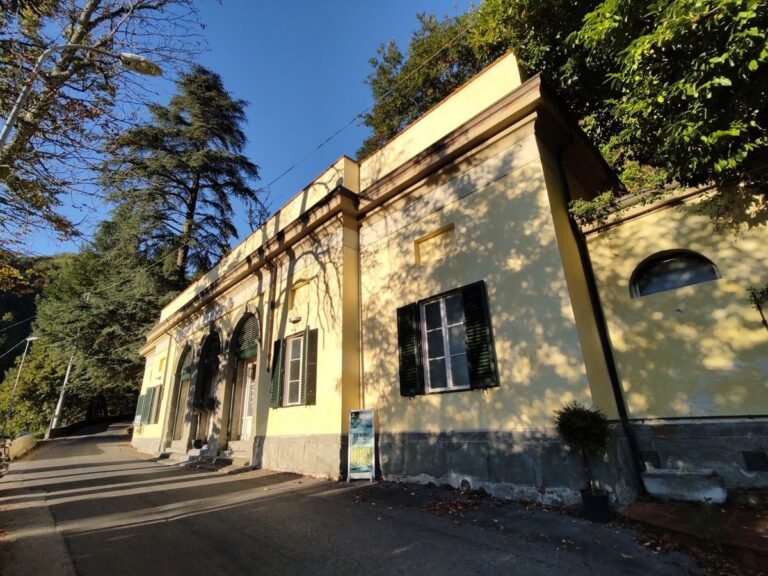
The yellow building of the Terme Bagno Bernabò, with green shutters and an OPEN sign, under tall cedars
Spa heritage

Terme di Bagni di LuccaThe thermal baths

The thermal baths that made the town famous across Europe as a spa destination in the nineteenth century.

Good to know: confirm current facilities, treatments and opening times before booking.

Read the history

The waters behind the town’s fame

The thermal springs are the reason Bagni di Lucca developed as a resort. Known in the Middle Ages as Bagni di Corsena, the settlement attracted visitors seeking relief from illness long before its nineteenth-century fashionable heyday. Among its best-documented early guests was the French writer Michel de Montaigne, who stayed for more than two months in 1581 while seeking treatment for kidney stones. The historic spa comprised several bathing establishments rather than a single complex.

The yellow building in the photograph is Bagno Bernabò, one of these historic establishments. Its early nineteenth-century redevelopment formed part of the improvements encouraged by Elisa Baciocchi, Napoleon’s sister, whose rule helped raise the resort’s international profile. Traditional bathing facilities, including individual marble tubs and a steam grotto, recall an era when taking the waters was a carefully structured routine. Together, the baths explain the hotels, villas and international community that grew around the springs.

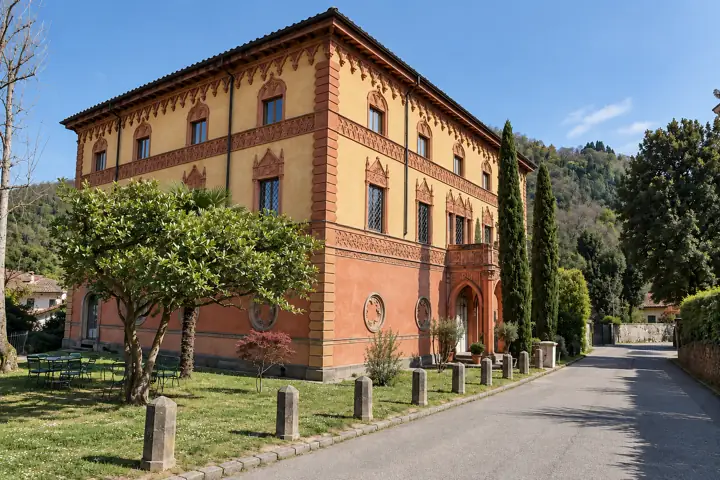
The ochre and terracotta Gothic-revival facade of the former Anglican Church in Bagni di Lucca, with pointed window frames and cypress trees
English heritage

Anglican Church

A surviving landmark of the English community that settled around the spa resort.

Good to know: best enjoyed as an architectural and cultural stop. There are no confirmed daily visiting hours.

Read the history

A home for the English community

The former Anglican Church is one of the clearest reminders of the British community that grew around Bagni di Lucca’s thermal resort. During the nineteenth century, English-speaking visitors increasingly became seasonal residents, creating a demand for familiar religious and social institutions. Henry and Elizabeth Stisted played a central role in securing permission for an Anglican place of worship from Duke Carlo Ludovico di Borbone around 1840. Previously, Protestant services had been permitted in the Hotel Pellicano.

Designed by Giuseppe Pardini, the building reflects the religious sensitivities of the time. Permission depended on its not looking too obviously like a church, so it took the outward form of a palazzo while incorporating Gothic-inspired details. Known as the “Palace of the English Nation”, it provided a spiritual and social focus for the community. No longer used for worship, it now houses the Adolfo Betti municipal library, giving this distinctive building a continuing role in the town’s cultural life.

English heritage

English CemeteryCimitero Inglese

Another important trace of the town’s nineteenth-century international community.

Good to know: check visitor access locally.

Read the history

A lasting international legacy

Opened in 1842, the English Cemetery records a more permanent side of Bagni di Lucca’s international spa society. Visitors came to the valley for health, recreation or an extended stay, but some never returned home. The cemetery provided a burial place for members of the Protestant community, whose religious needs were not met by the town’s Catholic institutions. Its foundation followed the permission obtained in 1840 by Henry and Elizabeth Stisted to establish both an Anglican church and cemetery.

The surviving monuments turn the resort’s cosmopolitan history into a collection of individual lives. Rather than simply recalling fashionable holidays, they testify to the people who settled here, formed connections and became part of the valley’s story. Read alongside the former Anglican Church, the cemetery helps explain how substantial the foreign community became: it needed not just accommodation and entertainment, but its own institutions for worship, remembrance and belonging.

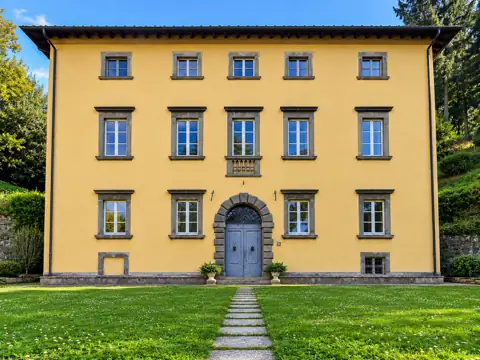
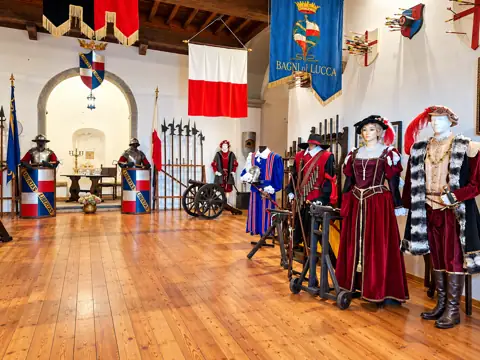
The yellow ochre facade of Villa Buonvisi Webb with grey stone window frames and an arched blue doorInside the Museo dell’Impossibile: period costumes, armour, pikes, a cannon and Bagni di Lucca banners
Museum

Villa Buonvisi WebbMuseo dell’Impossibile

A museum in the style of a Wunderkammer, or cabinet of curiosities, set inside a historic villa.

Good to know: check opening times and whether you need to reserve.

Read the history

A villa and cabinet of curiosities

Villa Buonvisi Webb brings together the history of an old residence and the deliberately unusual world of a cabinet of curiosities. Originally known as Villa Buonvisi, it later became associated with the Webb name and now houses collections that combine local history with unexpected objects. The displays extend beyond a conventional account of the building, introducing visitors to a museum experience shaped by discovery, surprise and the fascination of the unfamiliar.

The Museo dell’Impossibile occupies the villa’s upper floor and follows the spirit of a Wunderkammer: a collection in which natural specimens, unusual artefacts and seemingly extraordinary objects sit alongside one another. Its themes include folklore, alchemy, supernatural traditions and natural history. Some exhibits belong to the realm of imaginative storytelling rather than established scientific fact, an important distinction when exploring the collection. The appeal lies in that playful boundary between knowledge and belief, making the villa a very different stop from the town’s churches, bridges and spa buildings.

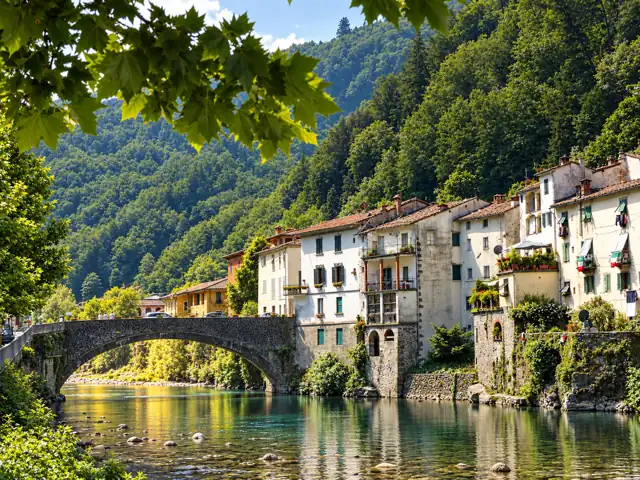
The stone arch bridge at Ponte a Serraglio over the clear River Lima, with riverside houses and wooded hills
River

The Lima riverside

Enjoy the river setting around Ponte a Serraglio. The Lima is also used for organised rafting trips.

Around Ponte a Serraglio

Good to know: rafting runs through local operators and is seasonal. Book ahead.

Read the history

The riverbanks of the River Lima

The River Lima has shaped the history and landscape of Bagni di Lucca for centuries. Flowing through the wooded Apennine foothills before joining the River Serchio, it has provided a natural corridor connecting settlements throughout the valley.

At Ponte a Serraglio, the historic stone bridge links communities on opposite banks. The settlement developed around this crossing, becoming closely associated with the fashionable spa resort that attracted European visitors during the eighteenth and nineteenth centuries.

The riverbanks have traditionally been places of everyday activity, offering access to the water and connecting riverside homes, roads and neighbouring villages. Their stone walls, bridges and closely grouped buildings remain distinctive features of the valley.

Today, the Lima continues to contribute to local life, attracting walkers, photographers and outdoor enthusiasts. Rafting and other river activities provide a more adventurous way to experience the valley.

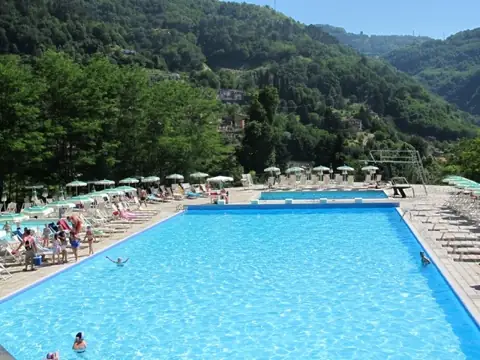
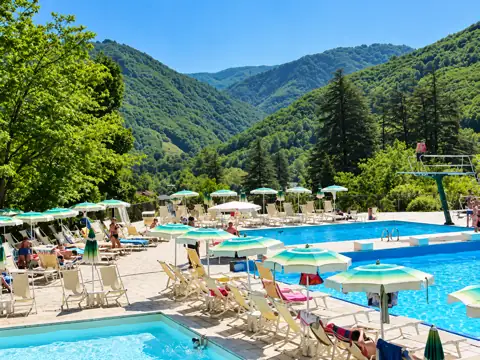
The large outdoor pool at Villa Ada with swimmers, sun loungers and the green hills of the Lima valleySun loungers and striped umbrellas around the Villa Ada pools, with a diving board and wooded mountains behind
Swimming · Seasonal

Villa Ada Swimming Pools

Public open-air pools in the grounds of a nineteenth-century villa, ringed by wooded hills. A favourite summer spot for swimming, diving and sunbathing, and reopened in June 2026, fifty years after they first opened.

Good to know: open in the summer season only. Check opening times and entry prices before you go.

Read the history

The public swimming pools at Villa Ada

The public swimming pools at Villa Ada form an important part of Bagni di Lucca’s recreational heritage. Set within the grounds of a historic nineteenth-century villa, the complex combines the town’s long association with bathing and its beautiful mountain surroundings.

Officially opened on 13 June 1976, during the administration of Mayor Enzo Tintori, the pools provided residents and visitors with modern outdoor swimming facilities. Surrounded by wooded hills, the complex became a popular summer destination, offering swimming, diving, sunbathing and opportunities for families to gather.

Over the following decades, Villa Ada became a familiar feature of summer life in Bagni di Lucca, attracting visitors from neighbouring villages and further afield.

Despite periods of closure and refurbishment, the pools have retained their place in local memory. Their reopening in June 2026, fifty years after their inauguration, marked a significant moment in the preservation of the town’s recreational heritage.

Mountain scenery and villages

2 attractions
Nature reserve · Seasonal

Orrido di Botri

A dramatic limestone canyon with steep walls, narrow passages, waterfalls and pools. One of the area’s principal natural attractions.

Access only from Ponte a Gaio

Good to know: this is a canyon excursion, not a roadside viewpoint. Check seasonal opening and conditions before travelling.

Mountain village

Lucchio and the Rocca di Lucchio

A mountain-village outing centred on Lucchio and the ruins of its fortress.

Upper Lima valley

Good to know: plan this as a walking excursion and check the route and conditions locally.

Visitor information

For current opening times and access, contact the Bagni di Lucca tourist information point. Opening of individual sites and activities can change through the year.

Address
Viale Umberto I, 97, Bagni di Lucca